
What is Encumbrance Certificate (EC)? Why is it Important in Property Purchase?
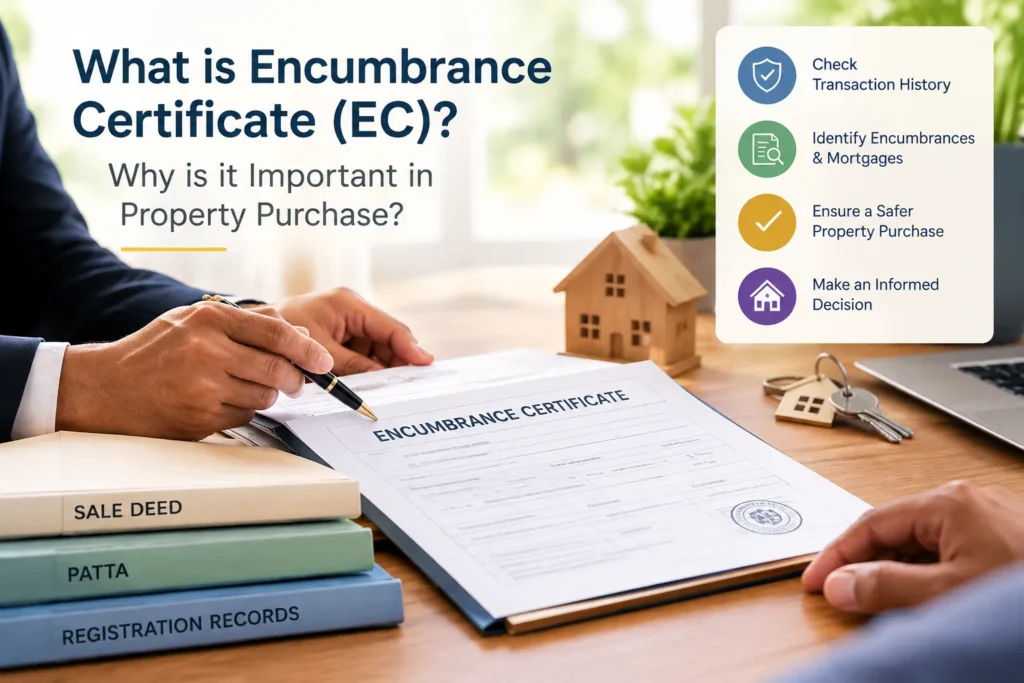
Buying a plot, house, or apartment is one of the biggest financial decisions many people make. But checking the property’s location, price, and amenities is only part of the process. Buyers also need to understand whether the property has any registered transactions, mortgages, or legal claims that could affect the purchase.
One important document used during property due diligence is the Encumbrance Certificate (EC).
An Encumbrance Certificate helps a buyer understand certain registered transactions and encumbrances recorded against a property for a specified period. However, it is important to understand what the document actually proves—and what it does not prove—before relying on it as the only legal verification.
This guide explains the purpose of the document, how it is obtained, what buyers should look for, common mistakes, and why it should form part of a broader property verification process.
What is an Encumbrance Certificate (EC)?
An Encumbrance Certificate (EC) is an official record issued through the registration system that provides information about registered transactions or encumbrances affecting a particular property during a specified period.
Depending on the records available and the type of transaction, the document may reflect matters such as:
- Registered sale transactions
- Mortgages or registered charges
- Certain release or discharge transactions
- Other registered instruments affecting the property
- The parties involved in recorded transactions
- Relevant document numbers and dates
In simple terms, an EC helps answer an important question:
“What registered transactions or encumbrances have been recorded against this property during the period checked?”
It is therefore an important part of property due diligence, particularly before purchasing land or a constructed property.
Is an EC proof that a property has a clear title?
No.
This is one of the most important points for property buyers to understand.
An EC is useful evidence of registered transactions, but it is not by itself a complete title-clearance certificate. It may not reveal every possible issue relating to ownership or the property.
For example, buyers may also need to verify:
- Parent or mother documents
- Current title deed
- Patta and revenue records
- Survey details
- Property boundaries
- Land classification
- Approved layout, where applicable
- Planning permission
- Building approvals, where applicable
- Court cases or disputes
- Government acquisition issues
- Tax and other statutory records
- Identity and authority of the seller
The exact checks required can vary depending on the property and transaction.
Why is an Encumbrance Certificate Important in Property Purchase?
Purchasing property without adequate due diligence can expose a buyer to financial and legal risks.
The registration records reflected in the certificate can provide valuable information about the property’s transaction history during the period requested.
1. Helps identify registered encumbrances
A property may have been offered as security for a loan or may have undergone other registered transactions.
Reviewing the available registration history can help identify such entries before the purchase progresses.
If a mortgage or other charge appears in the records, the buyer should understand whether it has been legally released before proceeding.
2. Helps verify transaction history
The document can provide useful clues about previous registered dealings involving the property.
This can be particularly helpful when comparing the registration record against the seller’s title documents.
If the documents tell one story but the registration history appears different, the discrepancy should be investigated rather than ignored.
3. Supports property due diligence
Buying property requires several layers of verification.
An EC is one component of that process. When reviewed alongside title documents and revenue records, it can help create a clearer picture of the property’s history.
4. Helps reduce avoidable financial risk
Property transactions involve substantial amounts of money.
Spending time on document verification before paying a significant advance can help buyers identify issues at an earlier stage.
This does not guarantee that every legal problem will be discovered, but it can reduce the risk of relying solely on verbal assurances.
5. Useful when obtaining property finance
Banks and financial institutions commonly conduct their own legal and documentation checks before approving property loans.
The documents requested can vary depending on the lender, property type, and transaction.
Having the relevant property records organized can make the verification process more straightforward.
What Information Can You Find in an EC?
The exact format and information can vary depending on the record and issuing system. Generally, buyers may see information relating to registered documents during the requested period.
| Information | Why it matters |
|---|---|
| Property identification details | Helps establish which property the record relates to |
| Document number | Identifies the registered instrument |
| Registration date | Helps establish transaction chronology |
| Transaction type | Shows the nature of the recorded transaction |
| Names of parties | Helps compare records with title documents |
| Consideration details, where recorded | Can provide transaction context |
| Mortgage or charge entries, where recorded | May indicate financial encumbrances |
| Release/discharge entries, where recorded | May indicate that an earlier charge was released |
The buyer should not interpret an entry in isolation. The underlying registered document may need to be examined for complete understanding.
How to Obtain an Encumbrance Certificate in Tamil Nadu
In Tamil Nadu, property registration records are administered through the state’s Registration Department.
The process may involve online services as well as registration-office procedures, depending on the requirement and the records available.
A typical process involves the following steps.
Step 1: Collect the correct property details
Before applying, gather accurate information such as:
- District
- Sub-Registrar Office (SRO)
- Village
- Survey number
- Subdivision number, if applicable
- Period for which the search is required
- Relevant document details, where available
Accuracy is important because an incorrect survey number or property identification detail can affect the usefulness of the search.
Step 2: Select an appropriate search period
An EC covers a specified period.
For example, a buyer may request records covering several years. The appropriate period depends on the property’s history and the legal advice received.
For older properties, title verification may require examination of documents going further back into the ownership chain.
Step 3: Review the result carefully
Do not simply check whether the certificate says there are no entries.
Compare the result with the documents provided by the seller.
Look for:
- Previous sale deeds
- Settlement or gift documents
- Mortgage entries
- Release deeds
- Partition-related transactions
- Other registered instruments
Step 4: Investigate discrepancies
If the EC and title documents do not match, stop and investigate.
For example, if a seller claims ownership based on a particular deed but the registration history appears inconsistent, professional legal review is advisable before proceeding.
What Does a “Nil EC” Mean?
A Nil EC generally means that no registered transactions or encumbrances were found in the records searched for the specified period, according to the certificate.
However, buyers should not interpret this as:
“There are absolutely no legal issues with this property.”
That conclusion would be too broad.
A Nil EC does not automatically establish:
- Perfect title
- Absence of all disputes
- Correct boundaries
- Valid land classification
- Valid planning approval
- Absence of every possible claim
- Absence of matters that are not reflected in the registration records
This is why a Nil EC should be considered one positive verification point rather than the entire title investigation.
What is the Difference Between EC and Title Verification?
These two checks serve different purposes.
| EC Check | Title Verification |
|---|---|
| Focuses on registered transactions/encumbrances in the searched period | Examines ownership and the legal chain of title |
| Provides registration-record information | Reviews title documents and supporting records |
| Helps identify recorded mortgages and transactions | Determines whether the seller can establish valid ownership |
| Limited by the period and records searched | May require examination of historical documents |
| One part of due diligence | Broader legal review |
A buyer should therefore avoid treating an EC as a replacement for a proper title examination.
Common Mistakes Buyers Make
Mistake 1: Checking only the latest EC
A short search period may not provide sufficient historical context.
The appropriate search period should be determined based on the property’s title history and professional advice.
Mistake 2: Assuming Nil EC means everything is clear
As explained above, the certificate does not cover every possible property issue.
A buyer should review the broader documentation.
Mistake 3: Not matching the survey number
Even a genuine certificate is of limited value if it relates to a different property or incorrect survey details.
Always cross-check the property identification particulars.
Mistake 4: Ignoring mortgage or release entries
If an earlier mortgage appears, buyers should verify whether it has been properly discharged or released.
The relevant release documentation should also be examined where applicable.
Mistake 5: Relying only on the seller’s verbal explanation
Property documentation should be independently verified.
Statements such as “the loan was already closed” or “the old document is not important” should not replace documentary evidence.
Mistake 6: Paying a large advance before verification
Buyers should ideally complete appropriate due diligence before committing substantial funds.
A lawyer can also advise on suitable agreement terms and safeguards.
How Far Back Should You Check?
There is no universal answer that applies identically to every property.
The required historical examination can depend on:
- Age of the property
- Nature of the title
- Previous ownership changes
- Land conversion or classification
- Development history
- Loan or mortgage history
- Availability of older records
- Requirements of the lender
- Legal advice
For a property with a complicated ownership history, examining only recent records may not be sufficient.
This is one reason experienced property lawyers often review the chain of title rather than looking at one document in isolation.
EC, Patta and Sale Deed: Are They the Same?
No. Each document serves a different purpose.
Sale Deed
The registered sale deed records the transfer of property from seller to buyer and contains important details about the transaction and property.
Patta
Patta is a revenue record associated with land/revenue administration. It can be useful for verifying revenue-record particulars, but it should not automatically be treated as conclusive proof of perfect title in every situation.
Encumbrance Certificate
The EC provides information from the registration records about registered transactions or encumbrances during the searched period.
Why all three may matter
A responsible property verification process compares information across multiple records rather than depending on one document.
Does an EC Show Court Cases?
Not necessarily.
An EC primarily reflects registered transactions and encumbrances available in the relevant registration records.
A legal dispute or court proceeding may not automatically appear simply because it exists.
Therefore, buyers should consider appropriate litigation checks and legal due diligence where necessary.
This distinction is especially important for high-value property purchases.
How Much Does an EC Cost?
The applicable government charges and service costs can depend on the application method, search period, property details, and current rules.
Because fees and procedures can change, buyers should check the Tamil Nadu Registration Department’s current official information before applying.
If a private professional or intermediary assists with the process, their service fee may be separate from official charges.
What Should Buyers Check Alongside an EC?
For a more comprehensive property review, consider checking the following:
Ownership and title
- Current sale deed
- Parent documents
- Previous title deeds
- Link documents
- Legal heir documents, where applicable
Revenue records
- Patta
- Chitta/adangal or relevant revenue records, where applicable
- Survey and subdivision details
- Land classification
Registration records
- EC
- Relevant registered instruments
- Mortgage and release documents
Planning and approvals
- DTCP/CMDA approval, where applicable
- Approved layout plan
- Planning permission
- Building approval, where applicable
Property-specific checks
- Physical boundaries
- Road access
- Tax records
- Water and drainage arrangements
- Existing structures
- Government acquisition concerns, where relevant
For a constructed property, additional checks may be required for the building and applicable approvals.
A Practical Property Verification Approach
Instead of asking only:
“Does the property have an EC?”
Ask a broader set of questions:
1. Who legally owns the property?
Trace the title documents.
2. Does the registration history match the title chain?
Compare the relevant registered documents with the EC.
3. Is there any recorded mortgage or charge?
If yes, verify the release/discharge documentation.
4. Does the physical property match the documents?
Check survey number, dimensions, boundaries and access.
5. Are the required planning approvals available?
Verify the applicable authority and approval documents.
6. Are there potential disputes or restrictions?
Consider appropriate legal and litigation checks.
7. Has an independent professional reviewed the documents?
For a significant investment, professional legal review can be worthwhile.
This approach is more reliable than treating any single certificate as a guarantee.
Why Professional Document Verification Matters
Property documentation can become complicated when there are multiple owners, subdivisions, inherited properties, old transactions, mortgages, layout changes, or differences between revenue and registration records.
Professionals experienced in property transactions can help identify inconsistencies that an ordinary buyer may overlook.
For buyers in Tambaram, Urapakkam, Guduvanchery, Vandalur, Padappai, Mannivakkam, Chengalpattu and surrounding areas, checking the relevant local property records and approvals is an important part of making an informed purchase.
A property professional can help organize the documents, while an independent property lawyer should be considered for legal title verification.
Frequently Asked Questions
1. What is an Encumbrance Certificate?
It is a registration-record document that provides information about registered transactions or encumbrances affecting a property during a specified search period.
2. Is an EC mandatory for buying property?
An EC is an important part of property due diligence, and it may also be requested by lenders or involved professionals. The exact documents required can vary according to the transaction.
3. Does a Nil EC guarantee clear title?
No. A Nil EC indicates that no relevant registered transactions or encumbrances were found in the searched records and period. It does not by itself guarantee perfect or undisputed title.
4. How many years of EC should I obtain?
There is no single period suitable for every property. The appropriate search period depends on the property’s history and should be determined as part of the title-verification process.
5. Can an EC reveal a property loan?
A registered mortgage or charge may appear in the registration records. If one appears, the buyer should verify the relevant release or discharge documentation before proceeding.
6. Is an EC the same as Patta?
No. Patta is a revenue record, while an EC provides information about registered transactions and encumbrances recorded during the searched period. Both can have different roles in property due diligence.
7. Should I consult a lawyer before buying property?
For a significant property purchase, obtaining independent legal advice can help assess title documents, registration records, approvals and potential legal issues before you commit substantial funds.
Final Takeaway
An Encumbrance Certificate is an important document in property due diligence because it provides useful information about registered transactions and encumbrances for a specified period.
But an EC should never be treated as the only proof that a property is legally safe to purchase.
The stronger approach is to examine the registration history alongside the title chain, revenue records, approvals, property details and other relevant legal checks.
If you are considering a plot or house purchase in and around Tambaram and Chengalpattu, take time to verify the documents before making a major financial commitment.
For assistance in understanding a property’s documentation and the checks that may be relevant to your purchase, you can speak with the NSR Crown Properties team and arrange a discussion or site visit. For legal title confirmation, an independent property lawyer should provide the final legal opinion.
Joint Patta vs Individual Patta: What Property Buyers Should Know
Residential Plot in Chennai: Buyer’s
How Infrastructure Projects Increase Property Value Around Tambaram
Add Your Heading Text Here
Lorem ipsum dolor sit amet, consectetur adipiscing elit. Ut elit tellus, luctus nec ullamcorper mattis, pulvinar dapibus leo.