
How to Verify Property Documents in Tamil Nadu Before Buying Land (2026 Guide)
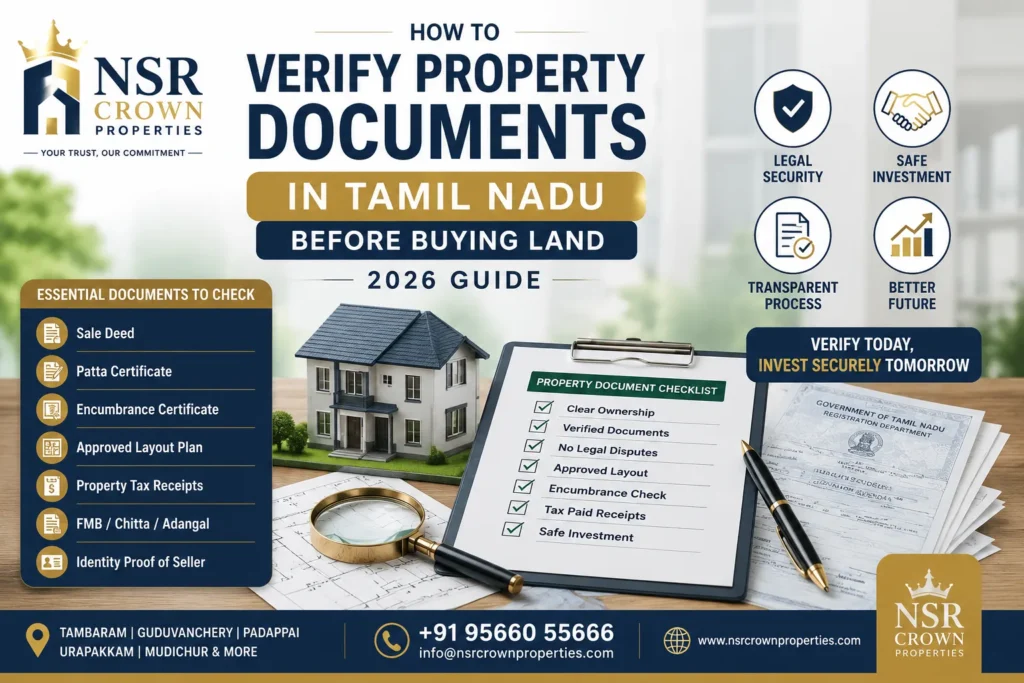
How to verify property documents in Tamil Nadu before buying land is one of the most important questions every property buyer should ask. Proper verification helps confirm ownership, identify legal risks, and ensure a safe investment decision before completing a land purchase.
Buying land is often one of the biggest financial decisions a person makes. Whether you’re planning to build your dream home or invest for the future, overlooking legal verification can lead to disputes, financial loss, or years of litigation.
Understanding how to verify property documents in Tamil Nadu before buying land is essential for making a secure investment. A visually attractive plot or an attractive price should never replace proper due diligence.
This guide explains the important documents to check, the verification process, common mistakes buyers make, and practical steps to help you purchase land with confidence.
Why Property Document Verification Matters
Many buyers focus only on location, price, and future appreciation potential. However, even a well-located property can become problematic if ownership records are unclear or approvals are incomplete.
Proper verification helps you:
- Confirm legal ownership.
- Identify existing loans or disputes.
- Ensure the land can legally be sold.
- Prevent future legal complications.
- Protect your investment and peace of mind.
A few days spent reviewing documents can save years of stress.
How to Verify Property Documents in Tamil Nadu Before Buying Land
1. Parent Documents
Parent documents establish the ownership history of the property.
These records show how ownership has transferred over time through:
- Sale deeds
- Gift deeds
- Partition deeds
- Settlement deeds
- Court orders (if applicable)
What to check:
- Clear ownership chain.
- No unexplained gaps in transactions.
- Consistency in survey numbers and boundaries.
2. Sale Deed
The sale deed is the primary legal document proving ownership transfer.
Verify:
- Seller’s name matches government records.
- Property measurements are accurate.
- Survey numbers are correct.
- Registration details are authentic.
If multiple owners exist, ensure all parties consent to the sale.
3. Patta Verification
Patta is a revenue record maintained by the Tamil Nadu government that identifies the lawful owner of the land.
Confirm the following:
- Seller’s name appears correctly.
- Survey number matches the plot.
- Land classification is appropriate.
- Extent of land is accurate.
Types of Patta:
- Individual Patta
- Joint Patta
Individual Patta generally provides greater clarity regarding ownership.
4. Encumbrance Certificate (EC)
An Encumbrance Certificate reveals whether the property carries financial or legal liabilities.
It helps identify:
- Existing mortgages.
- Loans secured against the land.
- Registered legal claims.
- Previous transactions.
Recommended practice:
Request an EC covering at least the previous 30 years.
If no registered liabilities exist, a Nil Encumbrance Certificate may be issued.
5. Approved Layout Documents
If purchasing a residential plot, confirm that the layout has received approval from the relevant authority.
Depending on the location, approvals may come from:
- CMDA
- DTCP
- Local planning authorities
Check for:
- Approval number.
- Approved layout plan.
- Compliance with development regulations.
6. Property Tax Receipts
Current tax receipts indicate that property taxes have been paid regularly.
Review:
- Latest tax payment records.
- Consistency in ownership details.
- Matching property descriptions.
Unpaid taxes may become the responsibility of the new owner.
7. Field Measurement Book (FMB)
The FMB sketch provides technical details regarding land boundaries.
It helps verify:
- Actual dimensions.
- Physical boundaries.
- Encroachments, if any.
This becomes particularly useful when neighboring properties share boundaries.
Step-by-Step Property Verification Process
Step 1: Collect all ownership records.
Request copies of:
- Parent documents.
- Sale deed.
- Patta.
- Tax receipts.
- EC.
Step 2: Match critical details.
Ensure consistency in:
| Document Detail | Verify Across Records |
|---|---|
| Owner Name | All documents |
| Survey Number | Sale deed, Patta, EC |
| Property Extent | Sale deed and FMB |
| Boundaries | Site inspection and records |
| Registration Details | Government records |
Step 3: Conduct a physical site visit.
During inspection, verify:
- Access roads.
- Boundary markers.
- Occupancy status.
- Nearby developments.
A site visit often reveals issues not visible in paperwork.
Step 4: Consult a qualified legal professional.
A property lawyer can:
- Review ownership history.
- Identify hidden risks.
- Verify document authenticity.
- Provide a legal opinion.
Professional review adds another layer of protection.
Common Mistakes Buyers Should Avoid
Purchasing without legal scrutiny.
Relying solely on verbal assurances can be risky.
Ignoring land classification.
Agricultural land may require additional approvals before residential use.
Overlooking joint ownership.
All legal owners should participate in the transaction.
Failing to review the EC.
Undisclosed liabilities can affect ownership rights.
Skipping physical verification.
Document accuracy should always be supported by site inspection.
Benefits of Following a Proper Verification Process
Financial Protection
Reduces the risk of investing in disputed properties.
Legal Security
Ensures ownership transfer occurs smoothly.
Easier Financing
Banks typically require clear documentation before approving loans.
Better Resale Value
Properties with complete records attract more buyer confidence.
How Much Does Property Verification Cost?
Costs vary depending on the complexity of the transaction.
Potential expenses may include:
- Legal consultation fees.
- Document retrieval charges.
- Survey verification costs.
- Registration-related expenses.
While verification involves some investment, it is significantly lower than the cost of resolving future legal disputes.
Building Confidence Through Professional Guidance
Experienced real estate professionals understand local regulations and documentation requirements.
Working with trusted advisors can help buyers:
- Navigate complex paperwork.
- Understand approval requirements.
- Make informed decisions.
- Avoid common pitfalls.
However, independent legal verification should always remain part of the process.
Frequently Asked Questions (FAQ)
1. Which documents are mandatory before buying land in Tamil Nadu?
Typically, buyers should review the sale deed, parent documents, Patta, Encumbrance Certificate, tax receipts, and layout approvals where applicable.
2. Why is an Encumbrance Certificate important?
It helps determine whether the property has outstanding loans, legal claims, or registered liabilities.
3. Can Patta alone prove ownership?
No. Patta is an important supporting record but should be reviewed along with registered ownership documents.
4. How many years of ownership history should buyers verify?
Many legal professionals recommend reviewing at least 30 years of ownership records.
5. Is legal consultation necessary for every land purchase?
While not legally mandatory, professional legal review significantly reduces risk.
6. What happens if survey details do not match?
Any discrepancy should be clarified before proceeding with the transaction.
7. Should buyers physically inspect the property?
Yes. Site visits help confirm boundaries, accessibility, and actual conditions on the ground.
Conclusion
Purchasing land is a major milestone, but enthusiasm should never replace due diligence. Taking the time to understand how to verify property documents in Tamil Nadu before buying land can protect you from avoidable legal and financial complications.
By reviewing ownership records, checking approvals, confirming government documentation, and seeking professional advice when necessary, buyers can move forward with greater confidence.
If you’re planning to invest in residential property, prioritizing transparency and documentation today can help secure your future tomorrow.