
Checklist Before Buying a Residential Plot in Chennai
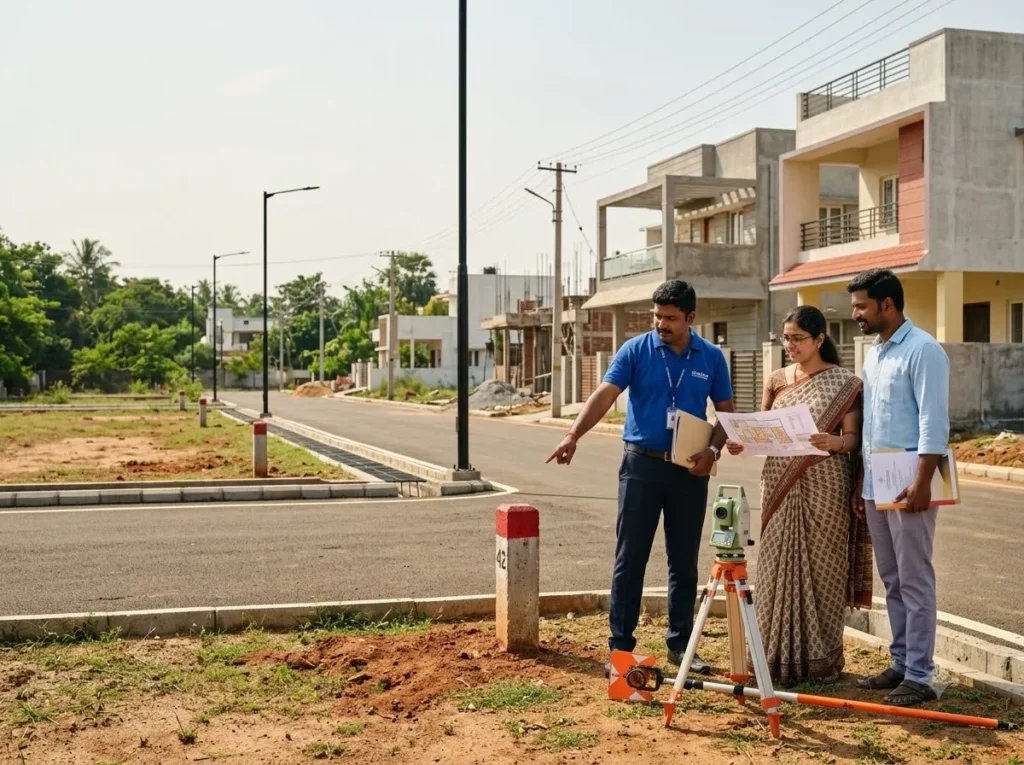
Buying a Residential Plot in Chennai is a major financial decision. Unlike purchasing a ready-built home, buying land requires careful verification of the property’s title, approvals, boundaries, access, infrastructure and associated costs before making a commitment.
Buying a plot is a major financial decision. Unlike purchasing a ready-built home, buying land requires the buyer to verify the property’s title, approvals, boundaries, access, infrastructure, development potential and associated costs before making a commitment.
For anyone planning to buy a Residential Plot in Chennai, the process can feel complicated because different locations may have different development patterns, road networks, approval requirements and future infrastructure plans.
A visually attractive plot at a good price is not necessarily a good investment. Proper due diligence is what separates a promising property from a potential legal or financial problem.
This checklist will help buyers evaluate a plot systematically before paying an advance or signing an agreement.
Why a Proper Land-Buying Checklist Matters
Land is a long-term asset, and mistakes made at the purchase stage can be difficult and expensive to correct later.
A proper verification process helps you:
- Confirm who legally owns the property
- Check whether the title is clear
- Verify applicable approvals
- Confirm the actual land measurements
- Understand road access
- Identify restrictions affecting construction
- Estimate the complete purchase cost
- Evaluate the location and surrounding development
- Reduce the risk of future disputes
The objective should not simply be to find the cheapest available land. The goal is to identify a property that is legally clear, practically usable and financially sensible.
Residential Plot in Chennai: Essential Buyer’s Checklist
Before finalizing a property, work through the following areas.
| Verification Area | What to Check |
|---|---|
| Ownership | Current legal owner |
| Title | Clear and transferable title |
| Approval | Applicable planning authority approval |
| Documents | Sale deed, parent documents and related records |
| Encumbrance | Existing mortgages, claims or registered charges |
| Survey | Survey number and subdivision details |
| Measurements | Actual dimensions and extent |
| Road Access | Legal and usable access road |
| Land Use | Whether residential development is permitted |
| Utilities | Electricity, water and drainage availability |
| Location | Schools, transport, hospitals and daily amenities |
| Flood Risk | Drainage and historical waterlogging |
| Costs | Registration, taxes, development and other charges |
1. Verify the Ownership and Title
The first question should always be:
Who legally owns the land?
Do not rely only on the seller’s verbal explanation.
A property lawyer should examine the title documents and establish whether the seller has the legal authority to transfer the property.
Check the Chain of Ownership
Depending on the property’s history, relevant documents may include:
- Current sale deed
- Previous sale deeds
- Parent documents
- Partition documents, where applicable
- Settlement or gift deeds, where applicable
- Legal heir documents, where applicable
The purpose is to understand how ownership has moved from previous owners to the current seller.
Why This Matters
A property may look perfectly legitimate but still have unresolved ownership issues.
Professional legal verification before paying a substantial advance can help identify such concerns early.
2. Check the Encumbrance Certificate
An Encumbrance Certificate (EC) is an important document to review during land due diligence.
It can help identify registered transactions or encumbrances associated with the property for the relevant period.
However, buyers should not treat an EC as the only proof that a property has a clear title.
A lawyer should review the EC together with the title documents and other relevant records.
3. Verify Planning Approval
One of the most important checks is whether the layout or development has received the applicable approval from the relevant planning authority.
In and around Chennai, buyers may encounter properties associated with authorities such as:
- CMDA
- DTCP
- Local planning authorities
- Local bodies, depending on the location and applicable rules
The applicable authority depends on the property’s exact location and planning jurisdiction.
Don’t Accept “Approved” as a Verbal Claim
Ask for the relevant approval documents and verify the details.
Important information can include:
- Approval number
- Layout details
- Survey numbers
- Approved road widths
- Open space reservations
- Plot numbers
- Approved extent
The approval details should correspond with the property being offered to you.
4. Match the Survey Number and Plot Details
A common mistake is checking documents without comparing them against the actual property.
Verify that the following correspond:
- Survey number
- Subdivision number
- Plot number
- Extent
- Boundaries
- Road position
- Location shown in approved plans
If there is a mismatch, stop the transaction until the discrepancy is professionally clarified.
5. Physically Measure the Plot
Do not assume the stated dimensions are accurate simply because they appear in a brochure.
A qualified surveyor can help verify:
- Plot length
- Plot width
- Total area
- Boundary alignment
- Road frontage
- Corner position
For example, a plot advertised as 1,200 sq. ft. should be checked against the actual measurements and documents.
Why Shape Matters
Two plots with the same area may have very different usability.
A regular rectangular plot may provide more efficient space for construction than an irregularly shaped property.
Consider the future building footprint, setbacks, parking and access before deciding.
6. Confirm Legal Road Access
Road access is one of the most important practical considerations.
A property may be physically reachable today but that does not automatically mean the access arrangement is legally secure.
Check:
- Width of the approach road
- Whether the road appears in approved layout documents
- Whether access is public or private
- Road connectivity to the main road
- Future road development plans where relevant
For corner plots, also consider how road-facing sides may affect the design and future construction.
7. Check Land Use and Construction Possibilities
Before buying land, understand whether the property can legally be used for your intended purpose.
For a residential purchase, buyers should verify applicable zoning and development regulations.
Also consider:
- Permitted building use
- Setback requirements
- Floor or height restrictions
- Road width requirements
- Building approval requirements
- Applicable local regulations
A plot that is legally suitable for residential construction is very different from land that merely looks suitable for housing.
8. Investigate Flooding and Drainage Conditions
This is particularly important when evaluating land around Chennai and its rapidly developing suburban areas.
Visit the property at different times if possible and speak with nearby residents.
Look for:
- Low-lying land
- Nearby water bodies
- Poor drainage
- Signs of previous waterlogging
- Road levels relative to the plot
- Stormwater drainage arrangements
Do not evaluate drainage only on a sunny day.
Understanding how the area behaves during heavy rainfall can be much more informative.
9. Check Electricity and Water Availability
Ask how basic utilities will be provided.
Electricity
Check:
- Existing electricity infrastructure
- Availability of nearby connections
- Whether individual service connections are practical
Water
Ask about:
- Groundwater conditions
- Existing water supply
- Borewell feasibility
- Local water arrangements
Drainage
Check whether the development has:
- Underground drainage
- Septic systems
- Stormwater drainage
- Other approved arrangements
Infrastructure can significantly affect the practical value of a plot.
10. Evaluate the Location Beyond Today
A good location should be evaluated from both the current-use and future-development perspective.
Consider proximity to:
- Schools
- Hospitals
- Railway stations
- Bus routes
- Main roads
- Employment centres
- Shopping areas
- Banks and essential services
For Chennai buyers, areas around Tambaram, Vandalur, Urapakkam, Guduvanchery, Padappai, Chengalpattu and other developing suburban corridors may attract attention because of ongoing residential and infrastructure development.
However, buyers should evaluate each micro-market individually rather than assuming that every property in a developing area will appreciate equally.
11. Study Future Infrastructure Carefully
Infrastructure can influence the attractiveness and accessibility of an area.
Potentially relevant developments include:
- Road expansion
- Railway improvements
- New transport facilities
- Industrial development
- Commercial centres
- Educational institutions
- Healthcare facilities
But be careful with claims such as:
“A new project is definitely coming here, so land prices will double.”
Future infrastructure should be verified through credible government or official sources wherever possible.
Unconfirmed promises should never be the primary reason for purchasing land.
12. Understand the Complete Cost
The advertised land price is not always the final amount you will spend.
Your budget should account for costs such as:
- Property price
- Stamp duty
- Registration charges
- Legal verification
- Survey charges
- Documentation expenses
- Brokerage, where applicable
- Development or maintenance charges, where applicable
- Construction-related site preparation
Simple Budget Example
Suppose a plot is advertised at:
₹40 lakh
The buyer should not automatically assume that ₹40 lakh is the complete acquisition cost.
Additional statutory and transaction-related expenses need to be calculated separately.
Before committing, ask the seller or developer for a clear cost breakup.
13. Compare Price With the Local Market
Price should be evaluated in context.
Compare similar properties based on:
- Location
- Approved status
- Road width
- Plot size
- Corner or interior position
- Infrastructure
- Development quality
- Accessibility
Two plots located only a few kilometres apart can have significantly different values because of connectivity, infrastructure and development characteristics.
Avoid comparing properties using only the price per square foot.
14. Visit the Property More Than Once
One site visit is rarely enough.
Try visiting:
Morning:
To understand traffic, surroundings and accessibility.
Evening:
To observe activity, lighting and neighbourhood conditions.
After rainfall:
If possible, to understand drainage and waterlogging conditions.
During the visit, speak with nearby residents. They can sometimes provide practical information that is not obvious from a brochure.
15. Watch Out for These Common Mistakes
Mistake 1: Paying an Advance Too Quickly
Don’t let urgency replace verification.
Complete basic legal and approval checks before making a significant payment.
Mistake 2: Trusting Only the Brochure
Marketing material can highlight advantages but may not contain every legal or technical detail.
Verify important claims independently.
Mistake 3: Ignoring Road Access
A property with inconvenient or legally uncertain access can create long-term problems.
Mistake 4: Focusing Only on Price
The cheapest plot is not necessarily the best value.
Mistake 5: Skipping Legal Verification
A professional property lawyer should review important documents before purchase.
Mistake 6: Ignoring Flood Risk
Location aesthetics should never replace practical environmental assessment.
Mistake 7: Assuming Approval Without Checking
Ask for approval documents and verify whether they actually correspond to the property.
Documents Buyers Should Review
The exact documents required can vary depending on the property and transaction. A legal professional can determine what is necessary.
Commonly reviewed records may include:
- Sale deed
- Parent documents
- Encumbrance Certificate
- Patta or relevant revenue records
- Survey records
- Approved layout documents
- Planning permission, where applicable
- Tax receipts
- Identity and ownership documents
- Release or partition documents, where applicable
- Power of Attorney, where applicable
The important point is not simply collecting documents. It is ensuring that the information across them is consistent.
How to Approach Land Due Diligence
A practical approach can be divided into five stages.
Stage 1: Shortlist
Compare several properties based on location, budget and intended use.
Stage 2: Site Inspection
Visit the property and evaluate roads, surroundings, infrastructure and physical conditions.
Stage 3: Document Verification
Have the relevant documents reviewed by a qualified property lawyer.
Stage 4: Approval and Survey Check
Verify planning approval, survey details, measurements and access.
Stage 5: Financial and Registration Planning
Calculate the complete transaction cost and proceed with the appropriate legal documentation only after satisfactory verification.
This structured approach reduces emotional decision-making.
How to Evaluate a Property Developer or Plot Seller
If you are purchasing from a developer, look beyond advertisements.
Check:
- Track record
- Completed projects
- Customer reviews
- Documentation practices
- Approval transparency
- Physical development quality
- Communication
- Post-sale support
Where possible, visit previously completed projects and speak with existing buyers.
Real-world evidence is generally more useful than promotional claims.
Questions to Ask Before Booking
Before paying an advance, ask:
- What is the exact survey number?
- Who is the legal owner?
- Is the layout approved by the applicable authority?
- Can I review the approval documents?
- Is the title legally clear?
- Can the property be independently surveyed?
- Is the road access legally documented?
- What are the additional purchase costs?
- Are there any mortgages, disputes or claims?
- What infrastructure is currently available?
- Are there any known restrictions affecting construction?
- Can I have the documents reviewed by my own lawyer?
A genuine seller should be comfortable with reasonable due-diligence questions.
Frequently Asked Questions
1. What should I check first before buying a plot in Chennai?
Start with ownership and title verification, followed by the applicable planning approval, survey details, road access and physical inspection.
2. Is CMDA approval required for every plot in Chennai?
Not necessarily. The applicable planning authority depends on the property’s exact location and jurisdiction. Buyers should verify which authority governs the particular property.
3. How do I know whether a plot has a clear title?
A property lawyer should examine the title chain, relevant documents, encumbrance records and other applicable records before purchase.
4. Should I get the plot surveyed before buying?
Yes. An independent survey can help confirm the property’s physical dimensions, boundaries and extent and identify discrepancies between documents and the site.
5. What additional costs should I budget for?
Apart from the agreed property price, buyers may need to account for stamp duty, registration, legal fees, survey expenses and other transaction or development-related charges.
6. Is location or approval more important when choosing land?
Both matter. A legally clear and appropriately approved property is essential, while location influences accessibility, usability, amenities and potential future demand.
7. Should I use a property lawyer before buying land?
Yes. Independent legal advice is strongly recommended for a significant land purchase because document requirements and legal circumstances can vary from one property to another.
Final Checklist Before You Buy
Before making a final decision, make sure you have:
Verified ownership
Reviewed the title documents
Checked the Encumbrance Certificate
Verified applicable planning approval
Confirmed survey and subdivision details
Physically measured the plot
Confirmed legal road access
Checked land-use and construction considerations
Investigated drainage and flood conditions
Checked electricity and water availability
Compared the local market
Calculated the complete purchase cost
Consulted an independent property lawyer
Visited the property personally
Conclusion
Buying land should be approached as a due-diligence exercise, not an impulse purchase.
A good residential property combines clear documentation, appropriate approvals, practical access, suitable infrastructure, a comfortable location and a price that makes sense for the buyer’s long-term plans.
Whether you are looking at established neighbourhoods or developing corridors around Chennai, take time to verify the facts before committing your money.
If you are considering a plot through a professional real estate provider, ask for the relevant property documents, approval details and project information and have them independently verified. A transparent process gives buyers greater confidence and helps create a stronger foundation for a future home or investment.
The right plot is not simply the one that looks attractive today—it is the one that remains a sensible property decision after every important detail has been checked.
CMDA Approved Plots in Tambaram
Real Estate Company in Tambaram
How Infrastructure Projects Increase Property Value Around Tambaram
RERA authorities – where the transaction falls within applicable real-estate regulatory requirements