
Joint Patta vs Individual Patta: What Property Buyers Should Know
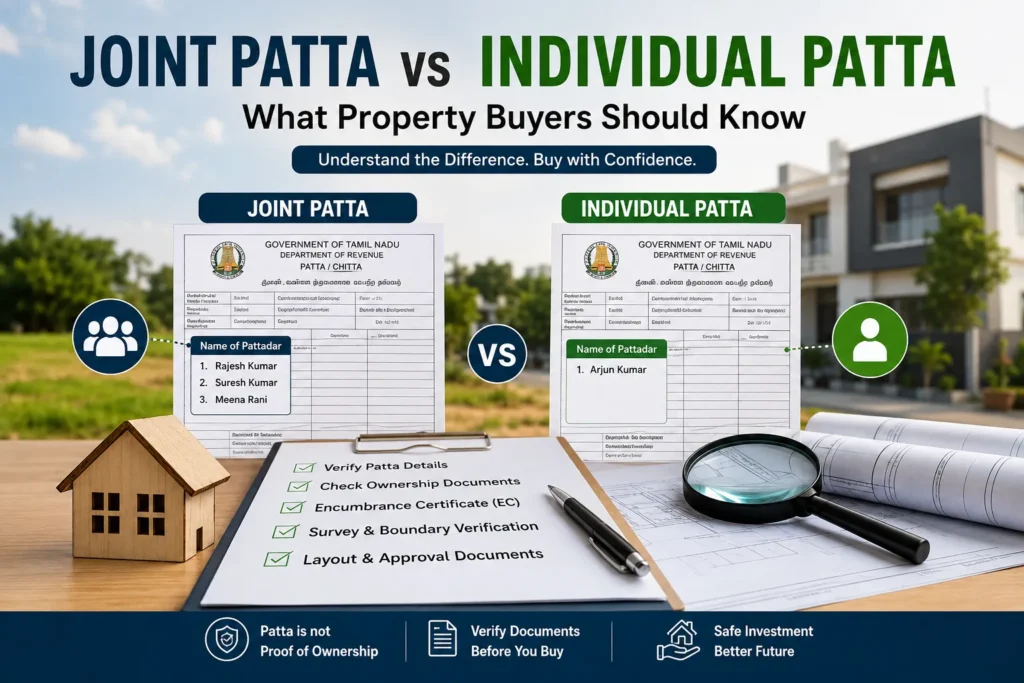
Buying a plot or house is a major financial decision, and checking the property’s documents is just as important as checking its location, price, or development potential. One document buyers frequently come across in Tamil Nadu property transactions is the Joint Patta vs Individual Patta issue.
Many buyers assume that having a patta automatically proves ownership. However, a patta is primarily a revenue record, and it should not be treated as a substitute for the registered title documents.
The distinction between joint and individual records becomes particularly important when purchasing residential plots, agricultural land, inherited property, or land that has been subdivided. Understanding what the revenue records actually indicate can help buyers identify potential complications before paying an advance.
In this guide, we explain the difference, advantages, limitations, verification process, common mistakes, and important checks that property buyers should complete before proceeding with a purchase.
What Is a Patta? (Joint Patta vs Individual Patta)
A patta is a revenue record maintained by the government that contains information relating to land and the person or persons recorded in connection with that property.
Depending on the property and its history, the record may contain details such as:
- Patta number
- Survey number
- Sub-division number
- Name of the recorded holder or holders
- Extent of land
- Classification or nature of the land
- Village and taluk details
- Other relevant revenue information
In Tamil Nadu, buyers may encounter these records while verifying land before purchase.
However, an important distinction should be understood:
A patta is not, by itself, conclusive proof of legal title.
Ownership should be established by examining the complete chain of title, including registered sale deeds, parent documents, partition deeds, settlement deeds, release deeds, court orders where applicable, and other relevant records.
What Is an Individual Patta? (Joint Patta vs Individual Patta)
An individual patta generally refers to a revenue record where the property is recorded in the name of a single person.
For example, if a residential plot is recorded under one person’s name in the revenue records, it may be described as having an individual patta.
This can make the revenue record relatively straightforward to understand because there is one recorded holder.
However, buyers should not conclude that an individual record alone guarantees that the seller has clear and marketable title.
The seller’s name should be consistent with the registered ownership documents and the property’s title history.
Example
Suppose Mr. Arun purchased a plot through a registered sale deed.
If the relevant revenue records subsequently reflect Mr. Arun’s name and the survey and subdivision details correspond with the registered documents, the records are generally easier for a buyer to reconcile.
But the buyer should still examine:
- The current sale deed
- Previous title documents
- Encumbrance Certificate
- Survey and subdivision details
- Land classification
- Approved layout documents, where applicable
- Any applicable planning or local authority approvals
What Is a Joint Patta?
A joint patta generally means that more than one person’s name appears in the relevant revenue record for the property or landholding.
This situation can arise for several reasons, including:
- Joint purchase
- Inherited property
- Family ownership
- Property received through succession
- Undivided interests in land
- Property that has not yet been formally partitioned
- Revenue records that continue to reflect multiple holders
For example, if three siblings inherit a piece of land and the revenue records continue to reflect all three names, the property may have a joint revenue record.
This does not automatically mean that buying the property is impossible.
The important question is whether the seller has legally transferable rights over the specific property or share being sold, and whether the necessary co-owners have consented or participated in the transaction where required.
Joint Patta vs Individual Patta: Key Difference
The simplest way to understand the distinction is to look at the number of persons recorded in the revenue record and then examine how that affects a proposed transaction.
| Factor | Joint Patta | Individual Patta |
|---|---|---|
| Names recorded | Multiple persons | Usually one person |
| Common situation | Family/inherited/joint ownership | Individual ownership record |
| Transaction complexity | Can be higher | Usually simpler |
| Co-owner verification | Important | Generally less complicated |
| Partition issues | May arise | Less likely, depending on title |
| Title verification | Essential | Essential |
| Patta alone proves ownership? | No | No |
| Need to verify registered documents | Yes | Yes |
The table shows why buyers should not judge a property solely by whether the patta is joint or individual.
The underlying title and transaction history matter more than the label attached to the revenue record.
Is Joint Patta Safe for Buying Property? (Joint Patta vs Individual Patta)
A joint revenue record is not automatically unsafe.
The risk depends on the property’s ownership structure and documentation.
For instance, consider land owned by three family members. If all three legally own the property and all required owners execute the appropriate transaction documents, the purchase may proceed subject to proper legal and document verification.
The situation becomes more complicated when:
- One co-owner attempts to sell the entire property
- Some legal heirs are missing from the transaction
- There is a pending partition
- Ownership shares are unclear
- A family dispute exists
- The property boundaries do not match the documents
- The seller cannot establish how they acquired their interest
- The revenue record and registered documents contain conflicting information
Therefore, buyers should ask a more useful question:
Does the seller have clear, transferable rights over the exact property being offered for sale?
Can One Person Sell Property Under a Joint Patta?
This depends on the legal ownership and the nature of the transaction.
If multiple persons have ownership rights, one person generally cannot simply represent themselves as the exclusive owner of the entire property without appropriate legal authority or participation from the other rights holders.
A person may potentially transfer their legally owned share, but the consequences can be very different from selling a clearly identified, separately owned plot.
This is why buyers should be particularly careful when a seller says:
“Only my name is enough; the other names are just in the patta.”
Such statements should not be accepted without documentary verification.
If multiple people have rights under the title documents, their rights need to be properly examined before a transaction is completed.
For complicated ownership situations, buyers should obtain advice from a qualified property lawyer rather than relying solely on the seller, broker, or informal opinion.
Joint Patta Does Not Always Mean Joint Ownership
This is one of the most important points for property buyers.
A revenue record and a title document serve different purposes.
Patta information can support the understanding of a property’s revenue status, but ownership is determined by the legally applicable title documents and other evidence.
For example, a property may have multiple names in a revenue record because of inheritance or historical revenue entries. Conversely, simply seeing one person’s name in a revenue record does not eliminate the need to investigate earlier ownership documents.
What should buyers compare?
Ideally, the following information should be cross-checked:
- Seller’s name
- Survey number
- Subdivision number
- Property extent
- Four boundaries
- Previous owner’s details
- Registered document numbers
- Nature of transfer
- Encumbrances
- Applicable approvals
Consistency between these records is an important part of due diligence.
Why Title Verification Is More Important Than Patta Alone
Imagine a buyer finds a plot with an individual revenue record and assumes everything is clear.
Later, during document verification, they discover that:
- The seller’s title is incomplete
- A previous transaction was not properly documented
- There is an unresolved inheritance claim
- The survey extent differs between documents
- An encumbrance exists
- The land falls under a different classification than expected
The patta status by itself would not resolve these issues.
That is why a proper property verification process should consider the entire title chain, rather than checking one document in isolation.
Documents to Check Before Buying a Plot
Before paying a significant advance, buyers should ask for and review the relevant property documents.
1. Current Sale Deed
The seller should provide the registered document through which they acquired the property.
Check:
- Seller’s ownership details
- Survey number
- Subdivision number
- Extent
- Boundaries
- Registration details
2. Parent or Mother Documents
Depending on the property’s history, previous ownership documents may be required to establish the chain of title.
These can include:
- Earlier sale deeds
- Partition deeds
- Settlement deeds
- Gift deeds
- Release deeds
- Other relevant registered instruments
3. Encumbrance Certificate
An Encumbrance Certificate, commonly called an EC, can help identify registered transactions and certain registered encumbrances affecting the property during the relevant period.
The period searched should be appropriate for the property’s history.
An EC should not be treated as the only title check, but it is an important part of due diligence.
4. Patta / Revenue Records
Check whether the details correspond with the property being offered.
Pay attention to:
- Names
- Survey numbers
- Subdivision numbers
- Extent
- Land classification
5. Layout Approval
For plotted developments, buyers should verify whether the layout has the required approval from the competent planning or local authority.
In Chennai and surrounding areas, buyers may encounter properties marketed using terms such as CMDA approved or DTCP approved. The buyer should verify the actual approval and its applicable conditions rather than relying only on advertising claims.
6. Survey and Boundary Verification
The physical property should match the documents.
If necessary, a qualified surveyor can help verify:
- Site dimensions
- Boundaries
- Survey identification
- Actual extent
- Access
How to Verify Patta Details in Tamil Nadu
Tamil Nadu provides online government services through which citizens can access certain land and revenue information.
Depending on the record and service available, buyers may be able to check relevant details using information such as:
- District
- Taluk
- Village
- Survey number
- Subdivision number
- Patta number
However, online information should be treated as one part of the verification process.
For a high-value property transaction, buyers should compare the online records with the original or certified documents and obtain professional legal advice where necessary.
Common Mistakes Property Buyers Make
Mistake 1: Assuming Patta Equals Title
This is perhaps the most common misunderstanding.
A revenue record should not replace proper title verification.
Mistake 2: Checking Only the Current Seller’s Document
A property may have changed hands several times.
The historical chain can be important in determining whether the seller’s title is properly derived.
Mistake 3: Ignoring Co-Owners
If several persons have ownership interests, buyers should identify all relevant rights holders.
Mistake 4: Not Comparing Survey Numbers
A buyer may physically inspect one plot while the documents refer to another survey or subdivision.
Always reconcile the physical property with the documentary description.
Mistake 5: Paying a Large Advance Before Verification
Buyers sometimes make payments because the property appears attractive or the seller claims that another buyer is interested.
A rushed payment can create unnecessary legal and financial complications.
Mistake 6: Relying Only on a Broker’s Assurance
A broker can help facilitate a transaction, but legal title verification should be independently conducted.
What About Inherited Properties?
Inherited properties require additional attention because several legal heirs may have rights.
Suppose a property originally belonged to a parent and was inherited by three children.
If the property remains undivided, the buyer needs to understand each person’s legal interest.
Important questions include:
- Who are the legal heirs?
- Has a partition taken place?
- Is there a registered partition document?
- Have any heirs released their rights?
- Are all necessary parties participating in the transaction?
- Are there pending disputes?
The names appearing in revenue records should be compared against the succession and title documents.
Joint Patta vs Individual Patta: Which Is Better?
There is no universal rule that an individual revenue record is always better than a joint one.
An individual record can make a property easier to understand from a revenue-record perspective, but that does not eliminate title-related risks.
Similarly, a joint record can be perfectly legitimate where the ownership structure is properly documented and all relevant parties’ rights are clear.
A better way to evaluate a property
Instead of asking only:
“Is the patta joint or individual?”
buyers should ask:
“Is the title clear, the ownership identifiable, the property correctly described, and the seller legally entitled to transfer it?”
That approach provides a much stronger basis for making a purchase decision.
Does Patta Status Affect Property Value?
Patta status can influence a buyer’s perception of a property, but it should not be used as the sole basis for determining market value.
Property value is influenced by factors such as:
- Location
- Road access
- Plot dimensions
- Development potential
- Planning status
- Surrounding infrastructure
- Demand
- Legal and documentation clarity
- Availability of utilities
- Land classification
- Nearby developments
A property with strong documentation and clear ownership can generally be easier to transact than one with unresolved documentation issues.
However, buyers should evaluate the entire property rather than assigning a value simply based on whether the revenue record is joint or individual.
What Should Buyers Do Before Paying an Advance?
A practical approach is to complete basic due diligence before making a substantial financial commitment.
Property Buyer Verification Checklist
Ownership
Confirm the seller’s identity
Review the current registered title document
Trace the previous ownership documents
Identify all relevant owners or legal heirs
Revenue Records
Verify patta details
Check survey number
Check subdivision number
Compare extent
Check land classification
Legal
Obtain an appropriate EC
Check for disputes or claims
Review relevant registered documents
Seek independent legal opinion for complex cases
Physical Property
Verify boundaries
Confirm road access
Match the site with the documents
Conduct a survey where necessary
Planning & Approval
Verify applicable layout approval
Check planning authority records
Confirm the property is being sold according to the approved layout, where applicable
How Professionals Can Help
Property documentation can become complicated when a transaction involves inheritance, multiple owners, subdivisions, old documents, or differences between revenue and registration records.
A qualified property lawyer can review the title chain and identify issues that may not be obvious to a first-time buyer.
Similarly, a licensed or qualified survey professional can help establish whether the physical site corresponds with the documentary description.
For buyers considering properties in Chennai and surrounding areas, professional verification is especially useful when dealing with rapidly developing locations where land parcels may have complex histories.
The objective should not simply be to complete the purchase quickly.
It should be to purchase a property whose ownership, documentation, boundaries, and approvals have been properly examined.
Frequently Asked Questions
1. What is the main difference between joint and individual patta?
A joint revenue record generally contains the names of multiple persons, while an individual record generally contains one person’s name. However, neither record by itself should be treated as conclusive proof of legal title.
2. Is a joint patta a problem when buying land?
Not necessarily. A joint record can arise from legitimate joint ownership or inheritance. The important issue is whether the seller has the legal right to transfer the property or their share and whether all necessary parties are properly involved.
3. Does individual patta guarantee clear ownership?
No. The buyer should examine the registered title documents, previous ownership records, encumbrances, survey details, and other relevant documents.
4. Can one co-owner sell the entire property?
Generally, a co-owner cannot simply transfer the rights belonging to other co-owners without appropriate legal authority or their participation. The exact legal position depends on the ownership documents and circumstances.
5. Is patta required for every property transaction?
The documentation requirements can vary depending on the nature and history of the property. Buyers should verify the applicable revenue and registration records rather than assuming that one document applies identically to every transaction.
6. Should I check the EC along with the patta?
Yes. The EC and revenue records serve different purposes. An EC can help identify registered transactions and certain encumbrances, while revenue records provide land-related information. Both should be considered alongside the title documents.
7. Should I consult a lawyer before buying property?
For a significant property purchase, obtaining an independent legal review is a prudent step, particularly where there are multiple owners, inheritance, old title documents, partition issues, or discrepancies between records.
Understanding the difference between joint and individual revenue records is an important part of property due diligence, but it should never be the only consideration.
A safe property purchase involves looking beyond a single document and checking the complete title chain, ownership rights, EC, survey details, boundaries, land classification, and applicable planning approvals.
For buyers in Chennai and across Tamil Nadu, taking time to verify the documents before paying an advance can help reduce avoidable legal and financial risks.
Whether you are purchasing a residential plot, an independent house, or land for future construction, make your decision based on verified documents rather than assumptions or verbal assurances.
If you are evaluating a property and are unsure which documents need to be checked, consider getting an independent legal and technical verification before proceeding with the transaction.
CMDA Approved Plots in Tambaram
Registration Charges and Stamp Duty in Tamil Nadu
Residential Plot in Chennai: Buyer’s Checklist
“Real Estate Regulatory Authority“