
How Infrastructure Projects Increase Property Value Around Tambaram
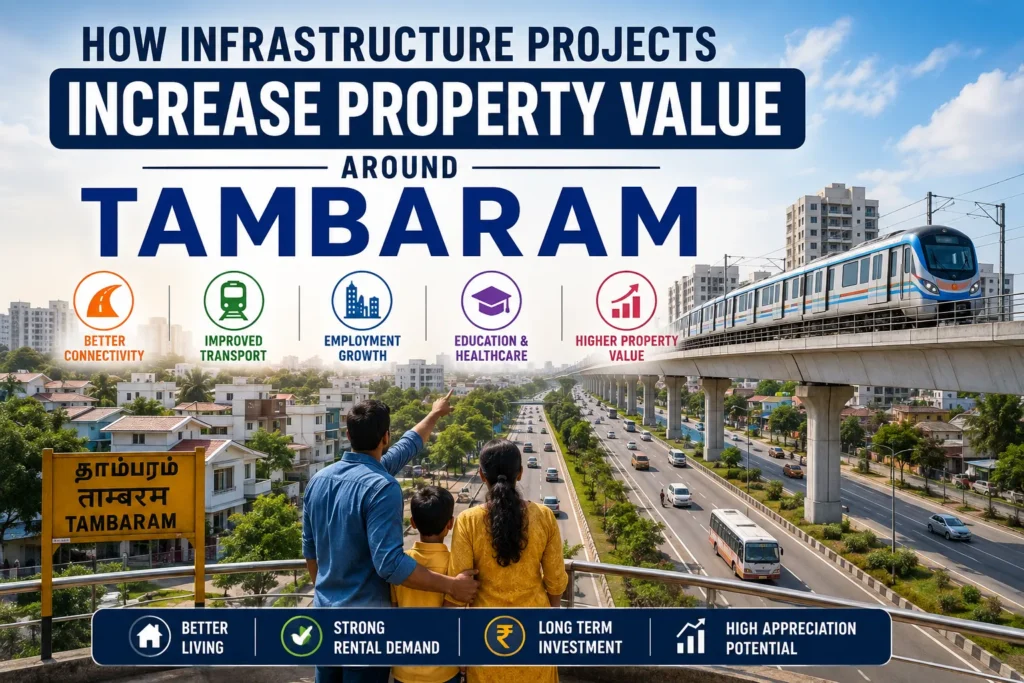
When buying land or a home, location is only one part of the investment decision. What often matters just as much is how the surrounding area is expected to develop over time.
For property buyers in Chennai, infrastructure projects around Tambaram have become an important factor when evaluating long-term residential and investment opportunities. Better roads, improved public transport, employment hubs, educational institutions and supporting infrastructure can make an area more accessible and attractive to future buyers and residents.
But infrastructure alone does not automatically guarantee higher returns.
The real question is:
How do infrastructure improvements influence property demand, and what should buyers look for before investing?
Let’s examine the relationship in detail.
How Infrastructure Projects Increase Property Value Around Tambaram
Infrastructure development can influence real estate values through several interconnected factors.
When travel becomes easier, businesses expand, employment opportunities increase and essential services become more accessible, the surrounding residential market can become more attractive.
For Tambaram and its surrounding suburbs, this can be particularly important because the region acts as a major residential and transportation zone connecting several parts of Chennai’s southern corridor.
1. Better Road Connectivity Improves Accessibility
One of the strongest factors affecting property demand is accessibility.
Road improvements can reduce travel time between residential areas and important destinations such as:
- Tambaram Railway Station
- GST Road
- Outer Ring Road
- OMR
- IT and industrial corridors
- Schools and colleges
- Hospitals
- Shopping and commercial centres
A property that was previously considered “far from the city” can become significantly more attractive when a better road connection reduces the practical travel distance.
Why does this matter to buyers?
People don’t necessarily purchase property based only on kilometres.
They often consider:
“How long will it take me to reach my workplace, school, railway station or main road?”
Improved connectivity can therefore increase the usefulness and desirability of nearby residential properties.
2. Public Transport Can Strengthen Residential Demand
Transport infrastructure is another major consideration.
Tambaram already has an established railway network and strong bus connectivity. Improvements or expansions in public transportation can further increase the attractiveness of nearby neighbourhoods.
For many homebuyers, particularly working professionals and families, easy access to public transport can reduce dependence on private vehicles.
Properties located within reasonable access to:
- Railway stations
- Bus terminals
- Major bus routes
- Future transit corridors
- Important junctions
may attract a wider pool of potential buyers and tenants.
However, buyers should distinguish between announced infrastructure and completed infrastructure. A proposed project should not be treated as an immediate benefit until there is reliable evidence of progress.
3. Employment Hubs Create Housing Demand
Infrastructure and employment growth often work together.
When industrial parks, IT hubs, business districts and commercial developments expand, they create employment opportunities. Employees then need places to live within reasonable commuting distance.
The Tambaram region benefits from connectivity toward several major employment corridors in South Chennai.
Areas connected toward:
- OMR
- Siruseri
- GST Road
- Oragadam
- Maraimalai Nagar
- Chengalpattu
can potentially benefit from increasing residential demand when employment and transportation infrastructure develop together.
The important connection
Infrastructure → Better connectivity → Employment accessibility → Housing demand
This is one of the reasons infrastructure should be considered as part of a property investment analysis.
4. Educational Institutions Increase Local Demand
Schools, colleges and universities can have a noticeable effect on residential demand.
Families often prefer locations where quality educational institutions are accessible without long daily commutes.
The development of educational infrastructure can support demand for:
- Individual houses
- Apartments
- Residential plots
- Rental properties
- Student accommodation in appropriate locations
For a property buyer, the important point is not simply whether a school exists nearby.
Consider:
- Travel time
- Road accessibility
- Number of institutions
- Quality and reputation
- Future development around the institution
These factors provide a better picture of the area’s long-term residential potential.
5. Commercial Development Can Transform Surrounding Areas
Infrastructure frequently encourages commercial activity.
As roads improve and population increases, businesses such as supermarkets, restaurants, clinics, banks, pharmacies and other services may establish themselves in the area.
This creates a positive feedback cycle:
More residents → More businesses → More services → Greater convenience → Stronger residential demand
This does not mean every property automatically becomes commercially valuable.
Land-use regulations, road width, zoning, approvals and local planning rules must be checked before assuming that a residential property can be used for commercial purposes.
6. Infrastructure Can Reduce Perceived Travel Distance
A common misconception among property buyers is to look only at geographical distance.
For example, two properties may both be 5 kilometres from a major junction, but one may have a wide, well-connected road while the other requires travelling through narrow internal roads.
The first property may feel significantly more accessible.
This is why experienced property buyers evaluate connectivity quality, not simply distance.
Look at:
- Road width
- Junction accessibility
- Traffic conditions
- Alternative routes
- Public transport
- Peak-hour travel time
- Future road development
7. New Infrastructure Can Improve Liveability
Property value isn’t determined purely by investment demand.
People also pay for convenience.
Infrastructure development can improve access to:
- Healthcare
- Education
- Shopping
- Recreation
- Public transport
- Employment
- Essential services
When everyday requirements can be reached more conveniently, residents may be willing to pay more for suitable housing.
This is particularly relevant for families planning to stay in a location for many years.
Which Infrastructure Projects Should Property Buyers Watch?
Not every infrastructure announcement has the same impact.
Before making an investment decision, examine the type and maturity of the project.
| Infrastructure | Potential Influence |
|---|---|
| Major road improvement | Better accessibility |
| Railway improvement | Easier commuting |
| Public transport expansion | Wider residential demand |
| Flyover / junction improvement | Reduced travel delays |
| IT / industrial development | Employment-driven housing demand |
| Schools & colleges | Family and rental demand |
| Hospitals | Better liveability |
| Commercial developments | Increased local convenience |
| Water & drainage infrastructure | Better long-term habitability |
The key is to assess multiple infrastructure factors together rather than relying on one announcement.
How to Evaluate a Property Near an Infrastructure Project
A good investment decision requires more than reading a property advertisement.
Use a simple five-step approach.
Step 1: Identify the Actual Project
Find out exactly what is being developed.
Is it:
- A road expansion?
- Railway improvement?
- New transport facility?
- Industrial project?
- Commercial development?
- Government infrastructure?
Understand the project’s actual scope.
Step 2: Check the Project Status
This is extremely important.
Classify the project as:
Announced → Approved → Funded → Under Construction → Operational
The investment implications can be very different at each stage.
Do not pay a premium based solely on an unverified future proposal.
Step 3: Measure Real Travel Time
Don’t rely only on statements such as “10 minutes from Tambaram.”
Check the route yourself.
Visit the property during:
- Morning peak hours
- Evening peak hours
- Weekends
A location that looks excellent on a map may have practical accessibility issues.
Step 4: Examine Existing Infrastructure
Future development is useful, but existing infrastructure matters too.
Look for:
- Proper approach roads
- Electricity
- Water availability
- Drainage
- Public transport
- Nearby shops
- Schools
- Healthcare
- Internet connectivity
A property with both good existing infrastructure and credible future development can offer a stronger proposition than one depending entirely on future projects.
Step 5: Verify Legal and Planning Details
Infrastructure potential should never replace due diligence.
Before purchasing land, verify:
- Title documents
- Patta
- Encumbrance Certificate
- Approved layout
- Planning authority approval
- Land-use classification
- Road access
- Survey details
- Property tax records
- Any applicable restrictions
For significant investments, buyers should consult qualified legal and property professionals.
Common Mistakes Buyers Make
Mistake 1: Believing Every Infrastructure Announcement
A proposed project doesn’t necessarily mean immediate development.
Always verify the current status through reliable sources.
Mistake 2: Paying an Unreasonable Premium
Infrastructure can support property demand, but sellers may sometimes price land based on future expectations.
Compare the property with similar properties in nearby locations.
Mistake 3: Ignoring Existing Problems
A future road or transport project cannot automatically solve issues such as:
- Poor drainage
- Flooding
- Narrow access roads
- Legal disputes
- Lack of basic utilities
Inspect the actual property and surrounding streets.
Mistake 4: Looking Only at Appreciation
A property should also work from a practical living perspective.
Ask:
Would someone actually want to live here?
If the answer is yes, the property may have a broader future buyer and rental market.
Infrastructure vs Location: Which Matters More?
The best investment usually combines both.
A property with an excellent location but poor connectivity may face limitations.
Similarly, a property far from established residential areas may not immediately benefit from a proposed infrastructure project.
A stronger combination is:
Good existing location + reliable connectivity + upcoming development + employment access + essential amenities
This combination can create a healthier foundation for long-term property demand.
What About Property Prices Around Tambaram?
Property prices vary considerably depending on the exact micro-market.
Factors include:
- Distance from Tambaram
- Main-road frontage
- Road width
- Plot dimensions
- Approval status
- Neighbourhood development
- Water availability
- Drainage
- Nearby transport
- Existing construction
- Future infrastructure
Therefore, buyers should avoid comparing two properties purely based on price per square foot.
A slightly more expensive property may offer better accessibility, approvals and surrounding development.
Why Infrastructure Matters for Long-Term Investors
Property is generally a long-term asset.
A buyer may hold a plot or house for five, ten or even twenty years.
During that period, the surrounding neighbourhood can change substantially.
An area with limited development today may eventually become a mature residential corridor if transportation, employment, education and commercial infrastructure develop consistently.
However, appreciation is not guaranteed.
Real estate values are influenced by market cycles, supply and demand, government policies, interest rates, local development and many other factors.
Infrastructure should therefore be considered as one important component of due diligence, not as a guaranteed return mechanism.
How Property Buyers Can Make a Better Decision
Before finalising a property around Tambaram, prepare a simple checklist:
Location
- Is the property easily accessible?
- Is the surrounding area already developing?
Connectivity
- How close is it to major roads and public transport?
- Are there alternative routes?
Infrastructure
- What projects are currently operational?
- Which projects are genuinely progressing?
Amenities
- Are schools, hospitals and shops accessible?
Employment
- How easily can residents reach major employment hubs?
Legal
- Are approvals and title documents clear?
Financial
- Is the asking price comparable with similar properties?
- Can you comfortably hold the property long term?
This approach reduces the chance of making an investment decision based on a single marketing claim.
Trust and Due Diligence Matter in Real Estate
A property consultant’s role should go beyond simply showing land.
Buyers should expect clear information about:
- Exact location
- Plot dimensions
- Approval status
- Road access
- Nearby landmarks
- Pricing
- Development status
- Documentation
For properties around Tambaram and other growing Chennai corridors, a transparent site visit and document verification process can help buyers make better-informed decisions.
If you are comparing properties, don’t hesitate to visit multiple locations and compare them based on connectivity, infrastructure, approvals, amenities and actual market conditions.
Frequently Asked Questions
1. Do infrastructure projects always increase property prices?
No. Infrastructure can support demand and improve accessibility, but property prices depend on several factors, including location, supply, demand, approvals, employment growth and broader market conditions.
2. Which infrastructure is most important for residential property?
Road connectivity and public transportation are particularly important because they directly influence commuting convenience. Employment, education, healthcare and commercial infrastructure also contribute to residential demand.
3. Is Tambaram a good area for long-term property investment?
Tambaram is an established transportation and residential hub in South Chennai. However, the suitability of a particular property depends on its exact location, price, legal status, connectivity and surrounding development.
4. Should I buy property based on a future infrastructure project?
It is better to treat future projects as one factor rather than the sole reason to invest. Verify the project’s official status and consider the property’s existing infrastructure and accessibility as well.
5. How can I verify an infrastructure project's status?
Check official government departments, planning authorities, transport agencies and other credible public sources. Avoid relying solely on property advertisements or social-media posts.
6. Does proximity to a major road always increase property value?
Not necessarily. Good accessibility can help, but excessive traffic, noise, pollution or difficult access can reduce residential appeal. The ideal property often balances connectivity with a comfortable living environment.
7. What should I verify before buying a plot around Tambaram?
Verify ownership, title, encumbrance, approval status, land classification, survey details, access road, utilities and applicable planning restrictions. Professional legal verification is recommended before completing the purchase.
Infrastructure development can play a powerful role in shaping the future of a neighbourhood.
Around Tambaram, improvements in transport connectivity, roads, employment corridors, education, healthcare and commercial infrastructure can influence how people choose where to live and invest.
But smart property investment is not about chasing the next infrastructure announcement.
It is about identifying locations where existing connectivity, genuine development, legal clarity, essential amenities and realistic future potential come together.
If you are exploring plots, houses or investment opportunities around Tambaram, compare multiple properties, verify the documentation and visit the locations personally before making a decision.
Looking for property opportunities around Tambaram and surrounding Chennai growth corridors? Explore available listings based on your preferred location, budget and investment objective, and arrange a site visit before taking the next step.